
Our SALUTE to BLACK ACHIEVEMENTS and Black History Month CONTINUES!
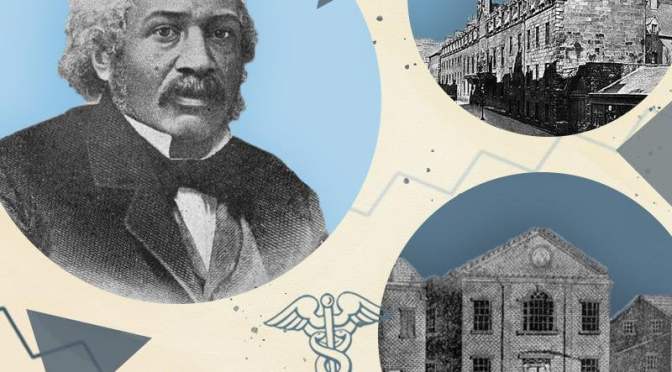
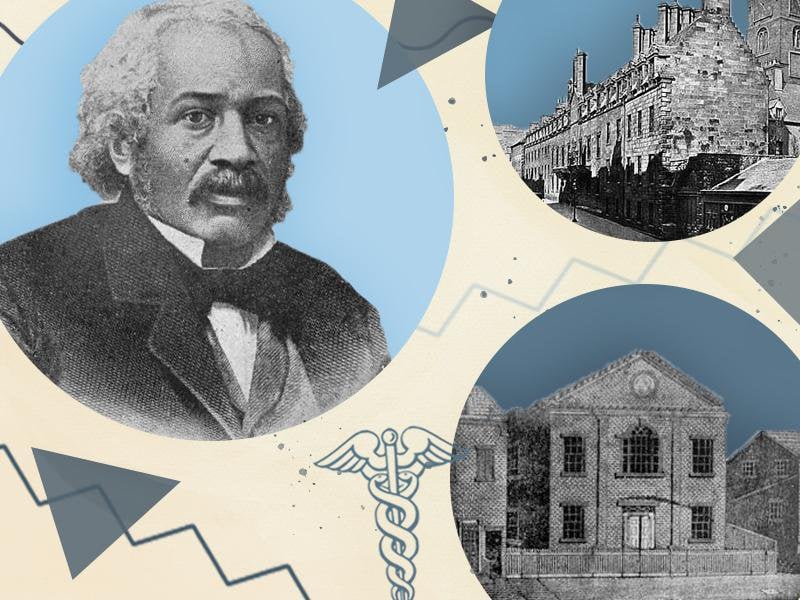
James McCune Smith was not just any physician. He was the first African American to earn a medical degree, educated at the University of Glasgow in the 1830s, when no American university would admit him. For this groundbreaking achievement alone, Smith warrants greater appreciation.
But Smith was also one of the nation’s leading abolitionists. In 1859, Frederick Douglass declared, “No man in this country more thoroughly understands the whole struggle between freedom and slavery than does Dr. Smith, and his heart is as broad as his understanding.” A prolific writer, Smith was not only the first African American to publish peer-reviewed articles in medical journals; he also wrote essays and gave lectures refuting pseudoscientific claims of black inferiority and forecast the transformational impact African Americans were destined to make on world culture.
John Stauffer, a Harvard English professor who edited The Works of James McCune Smith, says that Smith is one of the underappreciated literary lights of the 19th century, calling him “one of the best-read people that I’ve encountered.”
“The closest equivalent I really can say about [him] as a writer is [Herman] Melville,” adds Stauffer. “The subtlety and the intricacy and the nuance…and what he reveals about life and culture and society are truly extraordinary. Every sentence contains a huge amount.”
Smith was born enslaved in New York City, in 1813, to Lavinia Smith, a woman born in Charleston, South Carolina, who historians believe was brought to New York in bondage. While James McCune Smith never knew his father, a white man, university records indicate he was a merchant named Samuel Smith. (Amy Cools, a University of Edinburgh scholar who has conducted the most extensive research into Smith’s paternity, maintains, however, “Meticulous research has thus far failed to yield any records of [such] a Samuel Smith…indicating the name “Samuel” may possibly have been entered into [the] university records for convenience or respectability’s sake.”). Smith received his primary education at the African Free School #2 on Lower Manhattan’s Mulberry Street, an institution founded in 1787 by governing New York elites. Their aim was to prepare free and enslaved blacks “to the end that they may become good and useful Citizens of the State,” once the state granted full emancipation.
The school graduated a roster of boys who would fill the upper ranks of black intellectual and public life. Smith’s cohort alone included Ira Aldridge, the Shakespearean tragedian and first black actor to play Othello on the London stage; the abolitionist minister Henry Highland Garnet, the first African American to address Congress; Alexander Crummell, an early pan-Africanist minister and inspiration to W.E.B. DuBois; and brothers Charles and Patrick Reason, the first African American to teach at a largely white college and a renowned illustrator-engraver, respectively. These men’s achievements would be exceptional by any standard, but even more so, for a group who were born enslaved or deprived basic rights as free blacks.
He has been most well known for his leadership as an abolitionist; a member of the American Anti-Slavery Society, with Frederick Douglass he helped start the National Council of Colored People in 1853, the first permanent national organization for blacks. Douglass said that Smith was “the single most important influence on his life.” Smith was one of the Committee of Thirteen, who organized in 1850 in New York City to resist the newly passed Fugitive Slave Law by aiding fugitive slaves through the Underground Railroad. Other leading abolitionist activists were among his friends and colleagues. From the 1840s, he lectured on race and abolitionism and wrote numerous articles to refute racist ideas about black capacities.
Both Smith and his wife were of mixed-race African and European ancestry. As he became economically successful, he built a house in a good neighborhood; in the 1860 census he and his family were classified in that neighborhood as white, whereas in 1850 they were classified as mulatto. He served for nearly 20 years as the doctor at the Colored Orphan Asylum in New York but, after it was burned down in July 1863 by a mob in the New York Draft Riots, in which nearly 100 blacks died, Smith moved his family and practice out to Brooklyn for safety. The parents stressed education for their children. In the 1870 census, his widow and children continued to be classified as white. To escape racial discrimination, his children passed into white society: the four surviving sons married white spouses; his unmarried daughter lived with a brother. They worked as teachers, a lawyer, and business people.
Smith’s unique achievements as a pioneering African-American doctor were rediscovered by twentieth-century historians. They were relearned by his descendants in the twenty-first century when a three-times-great-granddaughter took a history class and found his name in her grandmother’s family bible. In 2010, several Smith descendants commissioned a new tombstone for his grave in Brooklyn. They gathered to honor him and their African-American ancestry.
 The Gamutt Blog