
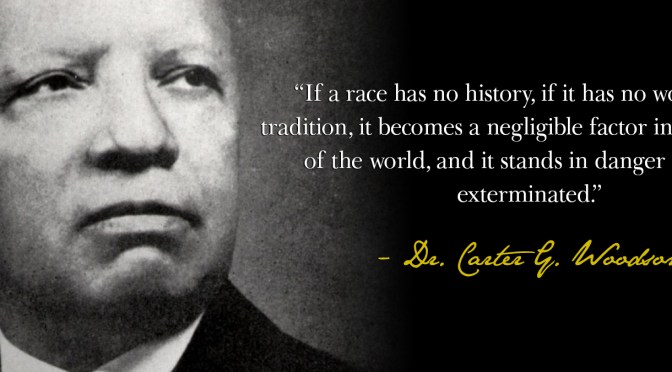
 In case you didn’t already know, the creator of Black History Month was historian Carter G. Woodson. Often referred to as the “Father of Black History,” he was notably the second African American to graduate from Harvard University with a doctorate degree and is credited with being one of the first scholars to study and research the history of African Americans.
Woodson was the second African American to receive a doctorate from Harvard, after W.E.B. Du Bois. Known as the “Father of Black History,” Woodson dedicated his career to the field of African American history and lobbied extensively to establish Black History Month as a nationwide institution. He also wrote many historical works, including the 1933 book The Mis-Education of the Negro. He died in Washington, D.C., in 1950.
After attending Berea College in Kentucky, Woodson worked for the U.S. government as an education superintendent in the Philippines. He undertook more travels before returning stateside to continue his studies, earning his bachelor’s and master’s degrees from the University of Chicago.
Woodson went on to receive a doctorate from Harvard University in 1912, becoming just the second African American to earn a Ph.D. from the prestigious institution, after Du Bois. After finishing his education, Woodson dedicated himself to the field of African American history.
Woodson wrote more than a dozen books over the course of his career, most notably Mis-Education of the Negro (1933). With its focus on the Western indoctrination system and African American self-empowerment, Mis-Education has become required reading at numerous colleges and universities.
Additional books from the author include A Century of Negro Migration (1918), The History of the Negro Church (1921) and The Negro in Our History (1922). Woodson also penned literature for elementary and secondary school students.
Woodson lobbied schools and organizations to participate in a special program to encourage the study of African American history, which began in February 1926 with Negro History Week. The program was later expanded and renamed Black History Month. (Woodson had chosen February for the initial weeklong celebration to honor the birth months of abolitionist Frederick Douglass and President Abraham Lincoln.)
Woodson died on April 3, 1950, a respected and honored figure who received accolades for his vision. His legacy continues on, with Black History Month being a national cultural force recognized by a variety of media formats, organizations and educational institutions.
Woodson’s accomplishments are also remembered through the University of Virginia’s Carter G. Woodson Institute for African American and African Studies, and the Dr. Carter G. Woodson African American Museum in St. Petersburg, Florida.
 The Gamutt Blog