
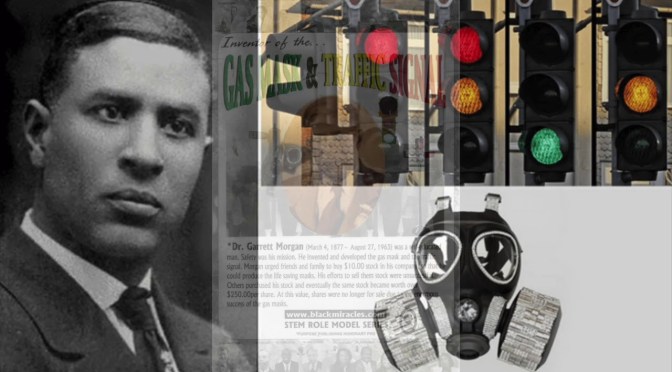
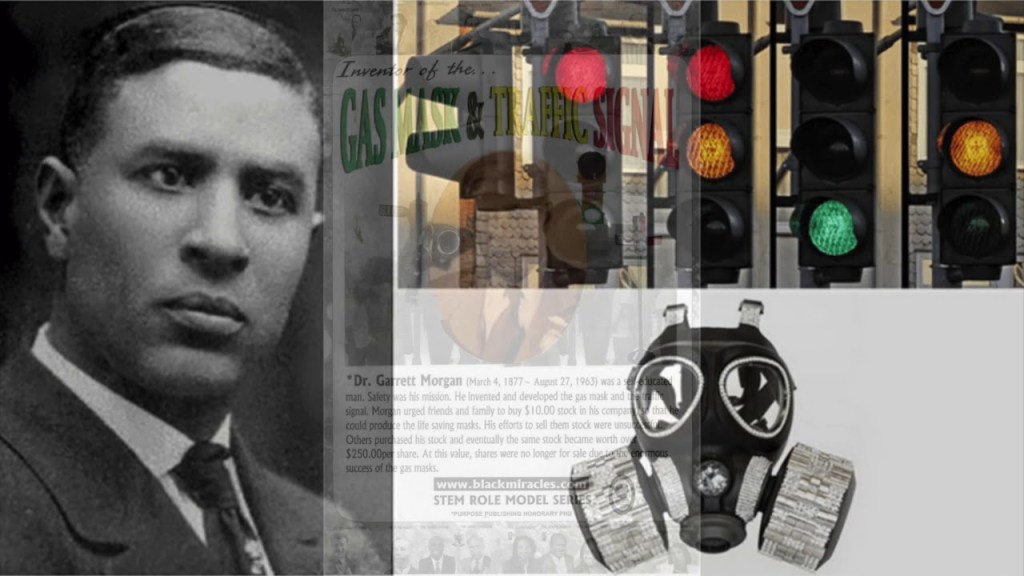
The gas mask – Invented by Garrett Morgan in 1912, the gas mask saved thousands of soldiers’ lives during World War I, when poisonous gas was first used as a weapon. If that weren’t enough, he also invented the modern traffic signal.
Garrett Morgan was an African-American inventor who invented two very different and important things: the gas mask and the traffic signal. During his long life, he also became one of the recognized and respected African-Americans in the country.
Garrett Augustus Morgan was born on March 4, 1877, in Paris, Kentucky. His parents were former slaves. As a child, he attended school and also worked on the family farm. When he was an older teen, he moved to Cincinnati to find work. He found it as an apprentice to a handyman, who paid young Garrett enough to hire a tutor and continue his studies. In 1895, Morgan moved to Cleveland, Ohio, where he worked repairing sewing machines for a clothing manufacturer. He married Madge Nelson in 1896, but the marriage ended in divorce. Word of his skill at fixing things and experimenting spread quickly throughout Cleveland opening up various opportunities for him.
Morgan experimented with a liquid that gave sewing machine needles a high polish and prevented the needle from scorching fabric as it sewed, even though this had never been an issue with needles. Accidentally, Morgan discovered that this liquid not only straightened fabric but also hair. He made the Liquid into a cream and began the G.A. Morgan Hair Refining Company. Morgan also made a black hair oil dye and a curved-tooth Iron comb in 1910, to straighten hair.
In 1920 Garrett Morgan started the Cleveland Call newspaper. As the years progressed, he became a prosperous and widely respected businessman. His prosperity enabled him to purchase a home and an automobile. Morgan’s experiences driving through the streets of Cleveland are what led him to invent the nation’s first patented three-position traffic signal.
Prior to Morgan’s invention, most of the traffic signals in use featured only two-positions: Stop and Go. Manually operated, these two-position traffic signals were an improvement over no signal at all, but because they allowed no interval between the Stop and Go commands, collisions at busy intersections were common during the transition moving from one street to the other. Another problem with the two-position traffic signals was the susceptibility to human error. Operator fatigue invariably resulted in erratic timing of the Stop and Go command changes, which confused both drivers and pedestrians. At night, when traffic officers were off duty, motorists frequently ignored the signals altogether.
The Morgan traffic signal was a T-shaped pole unit that featured three positions: Stop, Go and an all-directional stop position. The third position halted traffic in all directions before it allowed travel to resume on either of the intersection’s perpendicular roads. This feature not only made it safer for motorists to pass through intersections, but also allowed pedestrians to cross more safety. At night, or at other times when traffic was minimal, the Morgan signal could be positioned in a half-mast posture, alerting approaching motorists to proceed through the intersection with caution. The half-mast position had the same signaling effect as the flashing red and yellow lights of today’s traffic signals. Morgan’s traffic management technology was used throughout North America until it was replaced by the red, yellow and green-light traffic signals currently used around the world. The inventor eventually sold the rights to his traffic signal to the General Electric Corporation for $40,000. Shortly before his death in 1963, Morgan was awarded a citation for the traffic signal by the U.S. Government.
In 1912, Garrett Morgan received a patent on a Safety Hood and Smoke Protector. Two years later, a refined model of this early gas mask won a gold medal at the International Exposition of Sanitation and Safety, and another gold medal from the International Association of Fire Chiefs.
On July 25, 1916, Morgan made national news for using his gas mask to rescue several men trapped during an explosion in an underground tunnel beneath Lake Erie. Following the rescue, Morgan’s company was bombarded with requests from fire departments around the country that wished to purchase the new life-saving masks. The Morgan gas mask was later refined for use by U.S. soldiers during World War I.
He had contempt for people who thought they were better than others, either because of social standing or color. Though Morgan’s inventions and entrepreneurship afforded him a level of prestige, wealth and respect denied to many of his black contemporaries, he too experienced prejudice.
 The Gamutt Blog