
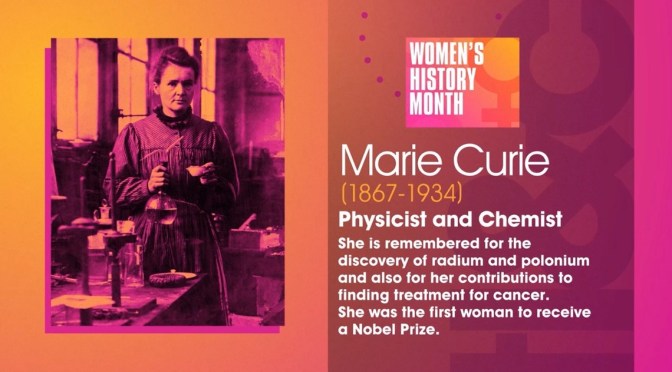
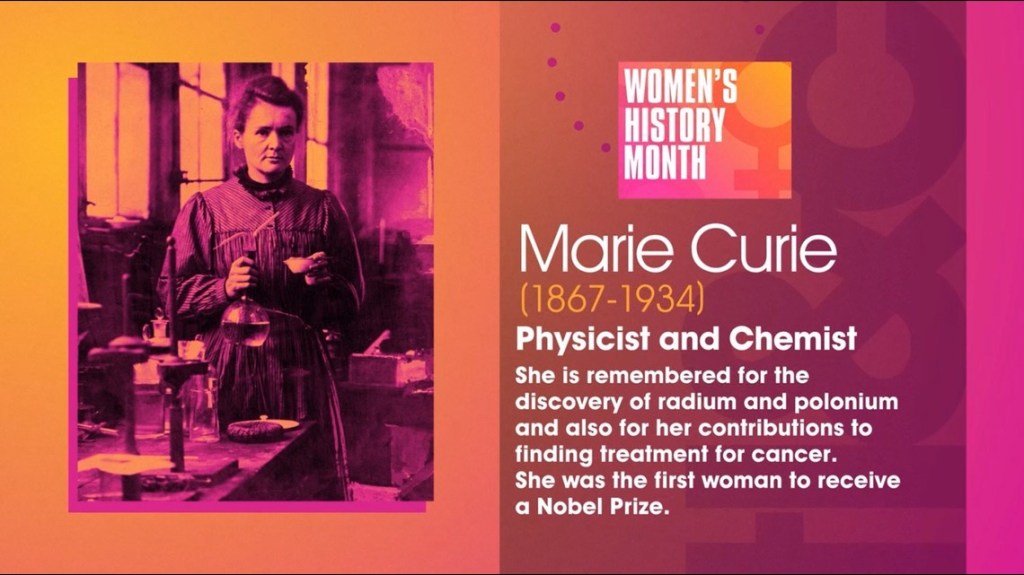
A salute to the first woman to receive a doctorate in France, the discoverer of two elements, the first person to win two Nobel Prizes and the mother of another winner.
It’s fitting to begin this celebration with a salute to the first woman to receive a doctorate in France, the discoverer of two elements, the first person to win two Nobel Prizes and the mother of another winner. It’s astonishing how much Marie Curie accomplished despite the obstacles in her way.
Marie Curie, nee Sklodowska, was born in Warsaw, Poland on November 7th, 1867. Russia dominated Poland at the time and discouraged Polish education. Despite that – and the death of her mother – she graduated with the highest honors from her high school. She then faced another closed door, for the University of Warsaw was closed to women. So Marie worked as a governess to pay for her sister Bronya’s studies in Paris and, after Bronya completed her degree, she supported Marie at the Sorbonne.
Marie eked by, studying in a tiny room that was so cold in winters that the water in her washbasin froze and she piled on all her clothes in order to sleep. Despite those Spartan student challenges – to say nothing of living far from home, in a new land and with a new language – Marie finished two master’s degrees, one in mathematics and the other in physics, in three years. She also met Pierre Curie, a fellow scientist, and married him the following year (1895).
Together, they began investigating the strange ‘rays’ (which we know as radioactivity, a term invented by Marie Curie) that French physicist Henri Becquerel had found to come from uranium salts. Denied a true laboratory, the Curies studied in a discarded dissecting room for the Sorbonne’s School of Medicine, which was freezing in the cold and leaky in the rain. They faced a further (and unknown) difficulty since, because of their radioactive nature, some of the elements the Curies were struggling to identify were literally transforming into different substances during the study. Yet they persevered and discovered two new elements, radium and polonium.
For those efforts, Marie and Pierre shared the 1903 Nobel Prize in Physics with Henri Becquerel. Fame . . . and even funding followed. And this year marks the centennial anniversary of her 1911 Nobel Prize in Chemistry. Yet hardships remained, as Pierre was killed in a tragic accident in 1906.
Marie dedicated the rest of her life to discovery and innovation: To learning more about radium and radioactivity and applying its properties to healing. During World War I, she oversaw the assembly of some 20 mobile X-ray stations, which were driven to the front and used by doctors caring for wounded soldiers. One of her assistants was her daughter Irène, who went on to win the 1935 Nobel Prize with husband Frédéric Joliot for, “their synthesis of new radioactive elements.”
Marie’s discovery of the chemical elements Polonium and Radium led to the invention of X-ray technology, forever changing the field of medicine. Without her spirit of innovation, we might not have mammography—a critical tool in the detection of breast cancer. Marie twice earned a Nobel Prize—and was the first woman to win the award—for these groundbreaking achievements

